Do Air Purifiers Help With Dust? What They Can and Cannot Remove

Yes, an air purifier can reduce dust that is suspended in the air and passes through its filters. It cannot vacuum a carpet, wipe a shelf or remove every particle before it settles. For a less dusty home, combine room filtration with cleaning and steps that reduce incoming dust.
This guide focuses on choosing and using an air purifier for dust. If your main question is where the dust keeps coming from, start with why your room gets so dusty.
What kind of dust can an air purifier capture?
Household dust is a mixture, including fibers, tracked-in dirt, skin flakes, pollen and material from pets. Some particles float long enough to reach a purifier. Others settle on the floor or furniture. Movement, cleaning and changing bedding can stir settled material back into the air.
| What you notice | What filtration can do | What else is needed |
|---|---|---|
| Fine particles floating in a sunbeam | Capture particles carried through the filter | Reduce indoor sources and incoming dirt |
| Dust on shelves and screens | Filter some dust while it is airborne | Wipe the surfaces with an appropriate damp cloth |
| Hair and lint on the floor | A pre-filter may collect material that reaches the intake | Vacuum floors and upholstery |
| Dust mite allergens in bedding | Capture some allergen-carrying airborne particles | Bedding care and humidity management |


Will an air purifier stop dust from settling on furniture?
Do not expect dust-free furniture. A purifier only processes the air that reaches it, and new dust is continually introduced. A clean filter or a low particle reading also does not prove that surfaces are clean. Keep a regular cleaning routine instead of waiting for the purifier to replace it.
A useful way to assess your routine is to pick one shelf and one floor area, clean them consistently and note how quickly dust returns. Keep track of open windows, pets, laundry and renovations. This can reveal a source worth addressing, although it is not a controlled test of purifier performance.
How to choose an air purifier for dust
Compare CADR with the room you want to clean
Clean Air Delivery Rate describes particle-cleaning performance. The EPA recommends matching CADR to the room. Measure the space, include connected open areas and check the ceiling-height assumptions behind coverage claims. Use our room-size and CADR guide before comparing models.
Check the filters and the speed you will actually use
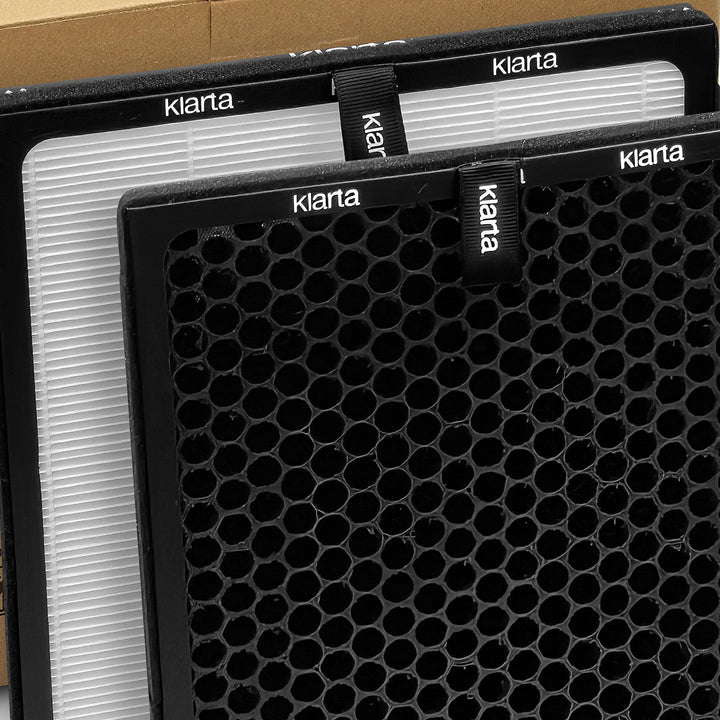
A pre-filter catches larger debris; the particle filter captures smaller airborne material. Activated carbon serves a different purpose, addressing certain gases rather than collecting settled dust. Look at both filtration and airflow. A maximum performance figure does not describe a quieter low setting.
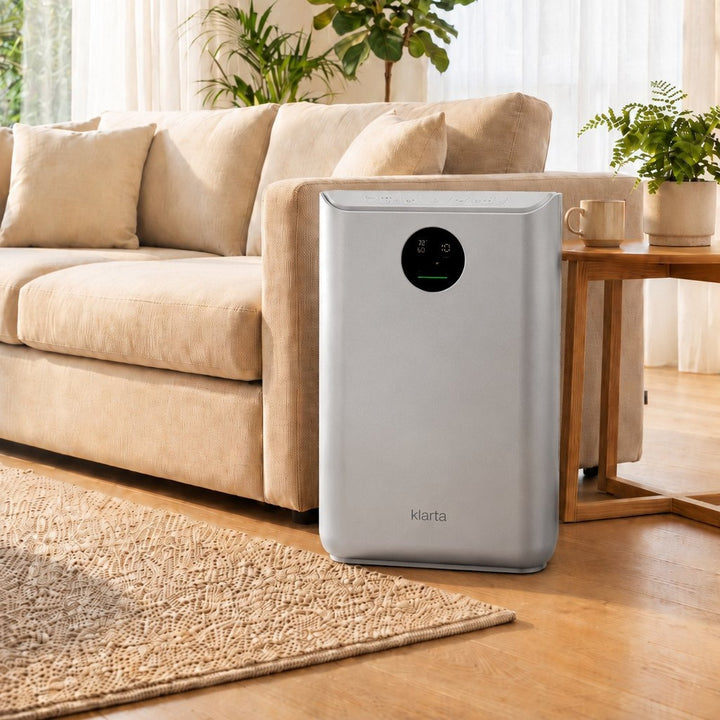
Make room for filter access and check replacement availability before buying. Klarta Forste and Stor sold in the USA use filtration and do not have ionization. Compare current specifications and prices on the Klarta air purifier collection.
A practical routine for a dusty room
- Limit tracked-in dirt. Use entry mats and keep outdoor shoes away from the areas you want to keep clean.
- Clean surfaces and floors. Work through shelves, upholstery and floor edges rather than only visible open areas.
- Give the purifier open airflow. Avoid curtains, blocked intakes and tight furniture gaps; follow the model's manual.
- Choose a sustainable operating setting. A device left off because it is too loud cannot filter the room.
- Inspect the pre-filter. Follow the cleaning instructions and replace other filters as directed. Read which air purifier filters can be washed before using water.
Dust, dust mites and pet allergens: which guide do you need?
If the problem is dust returning after cleaning, our daily dust checklist can help you organize the next steps. For bedding-related concerns, see air purifiers and dust mite allergens. If you live with a dog or cat, read our pet allergy guide.
Does a low PM2.5 reading mean there is no dust?
No. A PM2.5 sensor does not measure dust on a bookshelf or identify individual allergens. Use the display for its intended particle measurement, alongside cleaning and maintenance. Filtration is one part of managing a dusty home, not proof that every dust source has been removed.
For practical room layouts, see where to put an air purifier. For the difference between cooking, pet and smoke odors, read whether air purifiers remove odors.
Share:
Read also

Dust & allergens
Why Is My Room So Dusty? 10 Causes and Practical Fixes

Dust & allergens
Can Air Purifiers Help With Allergies? What the Science Says

Dust & allergens
Why Is My Room Dusty Every Day? A Practical Cleaning Routine

Comments