The Quietest Air Purifiers: What Decibel Ratings Really Mean

Search for "quiet air purifier" and you'll see a sea of numbers: 20 dB, 22 dB, 24 dB, "whisper quiet," "library quiet." They all sound great. The problem is that those numbers rarely tell the whole story, and two purifiers with the same rating on the box can sound completely different in your room.
So let's talk about what decibel ratings actually mean, why the lowest number isn't the one that matters most, and how to pick a purifier you won't end up switching off because it's driving you up the wall.
A quick decibel refresher
Decibels (dB) measure sound on a logarithmic scale, which is a fancy way of saying the numbers don't add up the way you'd expect. Every 10 dB increase sounds roughly twice as loud to the human ear. So a purifier at 50 dB doesn't sound a little louder than one at 40 dB. It sounds about twice as loud.
To give you some everyday reference points:
- 20 dB: rustling leaves, the quietest bedroom at night
- 30 dB: a whisper
- 40 dB: a quiet refrigerator hum
- 50 dB: moderate rainfall, a quiet office
- 60 dB: normal conversation
- 70 dB: a vacuum cleaner in the next room
You'll also see "dB(A)" on spec sheets. The A means the measurement is weighted to match how human hearing works, which is what you want when comparing appliances.
The number on the box is usually the lowest speed
Here's the thing most listings don't spell out: the headline noise rating is almost always measured on the purifier's quietest setting. That's the speed where the fan is barely turning and the purifier is doing the least amount of cleaning.
That's fine if you're only running it at night in a small room. But if you want the purifier to actually keep up with pollen season, a shedding dog or wildfire smoke, you'll be running it faster, and that's where the noise climbs. A purifier that's 22 dB on low might be 55 dB or more on high.
So when you compare models, look for the full noise range, from lowest to highest speed. Better yet, look at what the noise is on the medium speeds, because that's where most people run their purifier during the day.
Bigger is often quieter
This sounds backwards, but it's true. A purifier with a higher CADR (clean air delivery rate) can clean your room on a lower fan speed than a smaller unit running flat out. Lower fan speed means less noise.
If your room is 300 square feet and you buy a purifier rated for exactly 300 square feet, you'll probably need to run it on high to get good results. Buy one rated for a much larger space and you can run it on a low or medium setting, getting the same clean air with far less noise. If quiet matters to you, size up. Our room size guide walks through the math.
It's not just volume, it's the type of sound
Two purifiers at 40 dB can sound completely different. A smooth, low "whoosh" of air is easy to tune out and can even be relaxing. A higher-pitched whine, a rattle, or a motor that clicks when it changes speed is much harder to ignore.
A few things to watch for:
- Auto mode jumps. If a purifier constantly ramps up and down, the changes can be more noticeable than steady noise. Look for one that steps down gradually after the air clears.
- Beeps. Some purifiers beep every time you press a button or the mode changes. Fine in the kitchen, annoying at 2 a.m.
- Placement. A purifier on a hard floor next to a wall reflects more sound than one on a rug a few feet from the wall.
How loud are Klarta purifiers?
We publish the noise level at every speed, not just the quietest one, because we think you should know what you're buying.

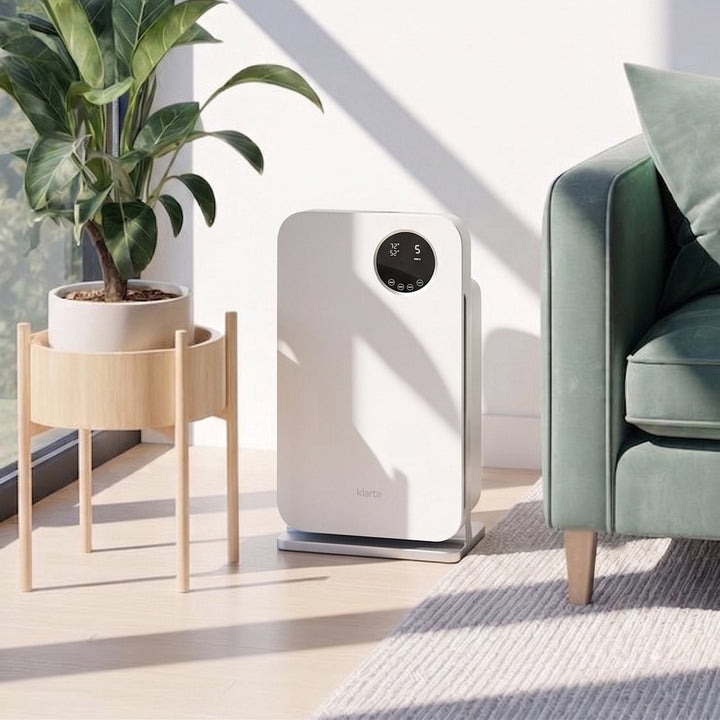
The Klarta Forste runs at 20 dB(A) in Sleep mode with the panel lights off. From there it goes to 26 dB on Silent, 43 dB on Slow, 53 dB on Fast and 66 dB on Turbo, its top speed. In its Auto Sleep mode it never goes above 36 dB, so even if the sensor picks up something at night, it won't wake you up. Sleep mode draws just 5 to 6 watts.
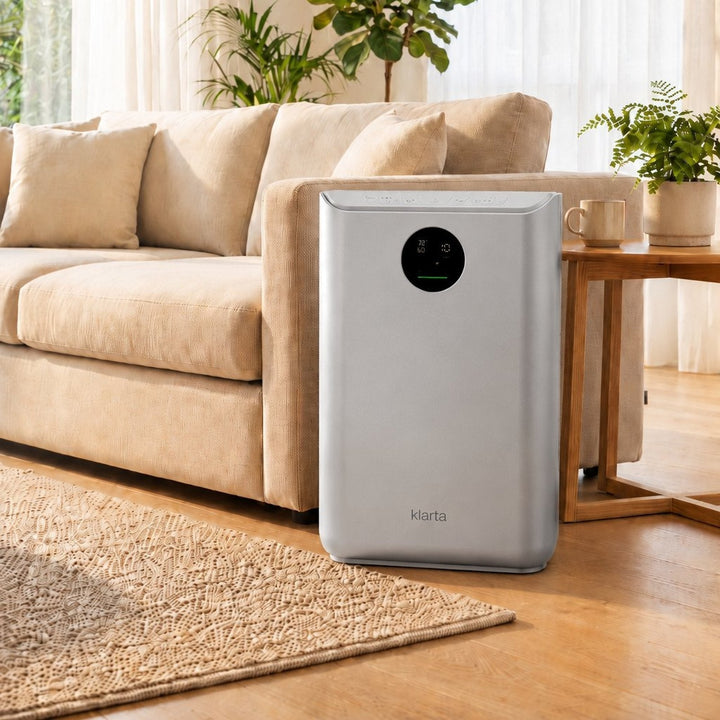
The Klarta Stor, our large-room model, runs at 24 dB(A) on Silent and in Sleep mode, 29 dB on Silent+, 36 dB on Slow, 48 dB on Slow+, 57 dB on Fast and 71 dB on Turbo. Because its CADR is so high (371 CFM), most rooms only need Silent or Slow to stay clean. Its Auto Normal mode skips Turbo and tops out at 57 dB if you want a quieter daytime setting.

Both models have a laser PM2.5 sensor, so in Auto mode they only speed up when there's actually something to clean, then step back down once the air clears.
A simple checklist for quiet
- Check the noise at every speed, not just the lowest.
- Choose a purifier rated for a bigger room than yours so it can run slower.
- Look for a true sleep mode that also turns off the lights.
- Make sure Auto mode has a quiet option for nighttime.
- Give it a few inches of space from walls and put it on a rug if you can.
Get those right and you'll end up with a purifier you forget is running, which is exactly the point. If the bedroom is your main concern, our guide to choosing a bedroom air purifier goes into more detail.
Comments