Air Purifier for Dust Mites: What It Can and Can't Do

An air purifier for dust mites can help capture airborne particles carrying mite allergens. Its role is limited, though: it cannot clean the inside of a mattress or replace washing bedding. The useful question is how to combine air filtration with care for the places where mites live.
This guide explains what mechanical filters and ionizers can and cannot do, which features matter when choosing a purifier, and the bedroom habits that belong alongside it.
Dust mites and airborne allergens are different things
Dust mites are tiny creatures that live in bedding, carpets and upholstered furniture. Their body fragments and droppings contribute allergens to household dust. Walking across a carpet, vacuuming or changing sheets can stir these particles into the air; they settle again after the disturbance. The American College of Allergy, Asthma & Immunology explains this pattern in its dust allergy guidance.
A purifier filters air passing through the unit. It can capture airborne particles, but it does not pull all the dust out of a pillow or remove a mattress's mite population. That distinction matters when comparing claims about “removing mites.”

Do air ionizers kill dust mites?
Klarta Forste and Stor sold in the United States do not have ionization. The following explanation concerns other air-cleaner technologies and does not describe a feature of Klarta US models.
Do not rely on an air ionizer to eliminate dust mites in bedding. A laboratory study published in 2012 found increased mite mortality with one commercial ionizer, with weaker effects when mites were protected by foam. It tested a specific device in controlled conditions, not Klarta purifiers in occupied bedrooms. Those results do not establish reliable mite control throughout a real home.
Ionizers and mechanical filters also work differently. Ionizers charge particles, which may collect on surfaces or on a collector inside a device. The EPA's explanation of ionizers notes that particles deposited around a room can become airborne again. Some electronic air cleaners can emit ozone, so check model-specific emissions information and avoid products intended to generate ozone.
What to look for in an air purifier for dust mite allergens
A mechanical particle filter
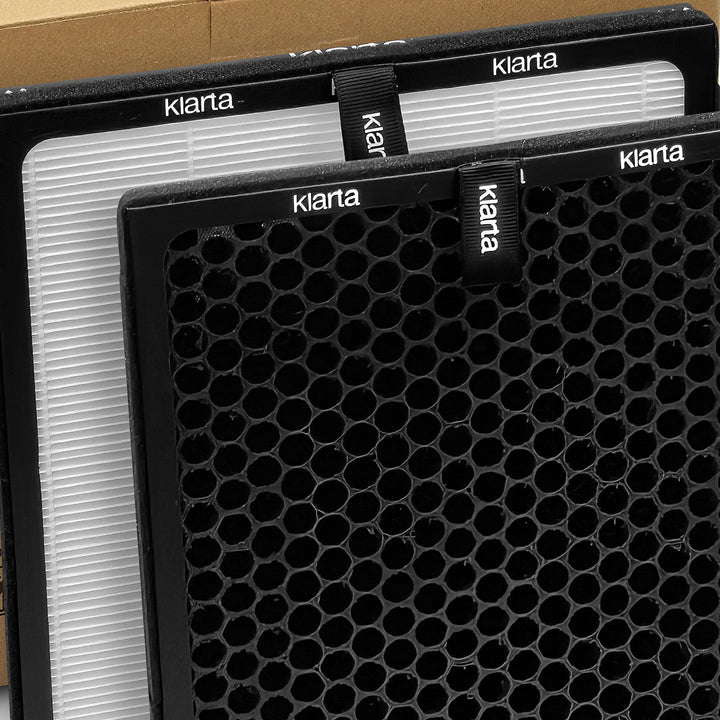
A mechanical air filter is designed to capture airborne particles. Look for clear filter specifications and replacement instructions. A filter's efficiency describes what happens to particles passing through it; it is not a promise to remove the same percentage of allergens from your entire room.

A CADR that fits your room
Clean air delivery rate, or CADR, describes particle-cleaning performance. The EPA recommends matching CADR to the room. Measure its length and width, then check the assumptions behind the advertised coverage, including ceiling height and air changes per hour. An open doorway into a larger space also changes the area you are trying to serve. Our air purifier room-size guide explains these comparisons.
A usable fan speed and accessible replacement filters
Consider the speed you will actually use, especially beside a bed. Higher speeds generally filter more air, while quieter settings move less. Check replacement-filter availability and cost before choosing a unit, and follow its maintenance instructions after installation.
Useful controls, with realistic expectations
Automatic controls can make daily use easier, but a PM2.5 sensor is not a dust mite detector. It measures fine-particle levels rather than identifying mite allergens or counting mites in bedding. A low reading therefore does not show that your bedroom is free of dust mite allergens. For example, the Klarta Forste uses a laser PM2.5 sensor to control fan speed; that reading is one piece of information about the room.
Four bedroom habits to use alongside filtration
The American Academy of Allergy, Asthma & Immunology recommends practical steps that address bedding and accumulated dust:
- Use protective covers. Encase mattresses and pillows in covers designed to limit dust mite allergen exposure.
- Wash bedding weekly. Build sheets, pillowcases and blankets into a regular laundry routine, following fabric care instructions.
- Clean floors and furnishings. Use a vacuum with a high-efficiency, small-particle filter and clean hard floors regularly.
- Manage humidity. Check it with a hygrometer. AAAAI recommends relative humidity of 30–50%; adding a humidifier automatically is not the right response to a dust mite concern.
These steps reach the surfaces and fabrics an air purifier cannot clean. They also give you a practical routine to maintain alongside filter care.

Where should the purifier run?
The bedroom is a useful place to start because you spend long periods there. Follow the unit's placement instructions and leave its intake and outlet clear of curtains, bedding and furniture. Choose a comfortable operating setting you can keep using. For a closer look at overnight settings and their tradeoffs, read our guide to running an air purifier at night.
Will an air purifier stop dust mite allergy symptoms?
No device can promise that. The EPA reports mixed results for improvements in allergy and asthma symptoms from portable air cleaners. Reducing airborne particles does not guarantee symptom relief. If symptoms persist, an allergist can help identify the cause and discuss appropriate care.
When you are ready to compare devices, browse Klarta air purifiers and choose around your room size, filtration needs and everyday use. Keep bedding care and humidity control part of the same plan.
Share:
Read also

Dust & allergens
Why Is My Room So Dusty? 10 Causes and Practical Fixes

Dust & allergens
Can Air Purifiers Help With Allergies? What the Science Says

Dust & allergens
Why Is My Room Dusty Every Day? A Practical Cleaning Routine

Comments